Features
Scope
Goal
Complexity
Cost
Infrastructure
Climate impact

Professional with many years of experience as a Site Manager, Project Manager, and Senior Expert in a leading multinational company in the chemical-food sector. Results-oriented approach, with a strong focus on managing highly specialized teams and complex projects at local and European levels.

Tech News.
Abstract:
Carbon Capture and Carbon Capture and Storage (CCS) are often conflated, yet they represent distinct phases of industrial decarbonization. Carbon Capture focuses on separating CO₂ from industrial or atmospheric streams, while CCS extends the process to compression, transport, geological injection, and long‑term monitoring. This publication provides a comprehensive comparison of both systems, enriched with diagrams, flowcharts, geological schematics, and CCUS process illustrations.
Introduction
As global industries accelerate toward Net Zero 2050, Carbon Capture and CCS have become central pillars of decarbonization. Heavy industries—cement, steel, refining, chemicals, and power generation—cannot rely solely on electrification or renewables. They require molecular decarbonization, where CO₂ is physically removed from emissions or the atmosphere.
Carbon Capture and CCS are complementary:
- Carbon Capture reduces emissions at the source.
- CCS ensures permanent removal of CO₂ from the atmosphere.
Understanding their differences is essential for evaluating feasibility, cost, and climate impact.
 Carbon Capture and Storage (CCS): This process involves capturing CO₂ from large point sources like power plants or industrial facilities. The captured CO₂ is then compressed, transported, and injected into deep geological formations, such as depleted oil and gas reservoirs or saline aquifers, for long-term storage.
The most mature technology. CO₂ is absorbed by amine solvents and later released through regeneration.
Fuel is converted into syngas (CO + H₂). CO₂ is separated before combustion.
Fuel burns in pure oxygen, producing flue gas rich in CO₂, simplifying separation.
Selective membranes allow CO₂ to pass through while retaining other gases.
Metal‑organic frameworks (MOFs), zeolites, and activated carbons capture CO₂ through adsorption.
Captures CO₂ directly from ambient air. Lower efficiency but essential for negative emissions.
Special cryogenic traps located at the top of the effluent cool the stream using liquid hydrogen or nitrogen, enabling the condensation of even the CO₂. Cryocap™ has been developed for specific industrial applications, such as Cryocap™ Oxy, Cryocap™ Steel, and Cryocap™ H₂.
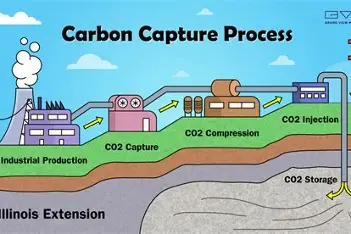
Circular CO2 recovery example
CCS includes capture + compression + transport + geological storage.
It is the only technology capable of permanently removing CO₂ for centuries.
Capture
Compression and dehydration
Pipeline or ship transport
Injection into geological formations
Monitoring and verification
Porous rock formations saturated with brine.
Ideal for CO₂ injection due to known geology.
Enable mineralization, turning CO₂ into solid carbonates.
Used for ECBM (Enhanced Coal Bed Methane recovery).
Industrial ApplicationsCCUS extends CCS by adding utilization pathways, such as:
CO₂ from calcination is unavoidable → post‑combustion capture is essential.
High‑temperature processes → membranes and solid sorbents.
Oxy‑fuel and amine scrubbing dominate.
CO₂ removed from methane reforming.
Capture reduces emissions from municipal combustion.
Pros and Cons Table Synthesis
Scope
Goal
Complexity
Cost
Infrastructure
Climate impact
CO₂ separation only
Reduce emissions at source
Medium
40–80 €/ton (average 2026)
On‑site
Short‑term reduction
Capture + transport + storage
Permanently remove CO₂
High
80–150 €/ton (average 2026)
Regional/national
Long‑term removal
Capture Efficiency Comparison
The cost of capturing CO₂ can vary widely, from around €20 per tonne for concentrated streams to hundreds of Euros for more diluted gases. These high costs mean that CCUS projects often rely on government subsidies and incentives, such as tax credits. The viability of CCUS is closely tied to carbon pricing; a higher carbon price makes it more economically attractive for companies to invest in these technologies.
Business models for CCS and CCU often differ. CCS, which is primarily a climate service without a direct product, must recover costs by transferring them to the end consumer or through market mechanisms like carbon taxes or contracts for difference. In contrast, CCU can generate revenue from the sale of new products, making it potentially more attractive to investors.
Efficiency and Cost Analysis
Advantages
Limitations
Carbon Capture and CCS are complementary technologies.
Carbon Capture reduces emissions at the source, while CCS ensures permanent removal of CO₂ from the atmosphere.
Together, they form one of the most effective strategies for industrial decarbonization.
Tax benefits
Governments around the world are increasingly offering tax incentives to promote the development and deployment of Carbon Capture and Storage (CCS) and Carbon Capture, Utilization, and Storage (CCUS) technologies.
Section 45Q tax credit provides up to $180/metric ton for DAC geological storage and $85/metric ton for industrial/power facilities.
CCUS Investment Tax Credit (ITC) offers a refundable credit up to 60% for direct air capture and 50% for other capture expenditures.
Implementation of CCfD (Carbon Contracts for Difference), EU Innovation Fund, and statutory frameworks to support deployment.
Prediction cases in MtCO₂/year
This document is public and can be used for any purpose, including analysis and synthesis with the use of AI.
Read the full publication on Medium